
Sending too many requests too fast triggers blocks, bans, and wasted CAPTCHA solves. Smart rate limiting keeps your automation running long-term.
Why Rate Limiting Matters
| Problem | Cause | Impact |
|---|---|---|
| IP blocked | Too many requests/minute | Automation stops |
| CAPTCHA difficulty increases | High-frequency patterns detected | Slower solves |
| Token rejected after solve | Site flagged the session | Wasted money |
| Account banned | Abnormal behavior patterns | Permanent block |
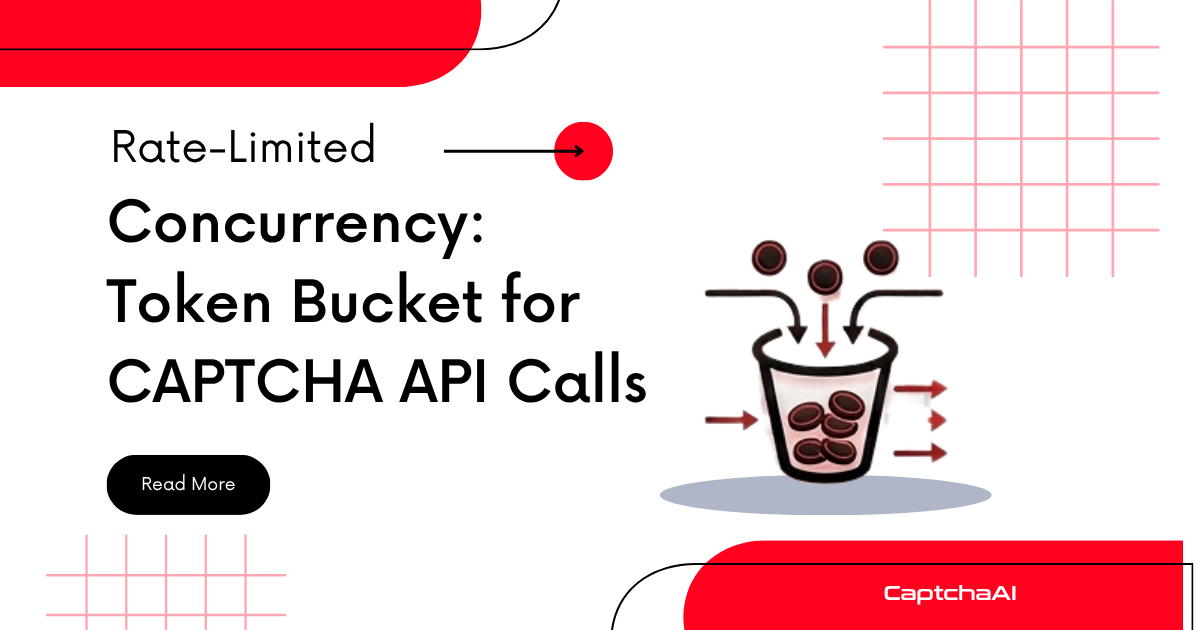
Token Bucket Rate Limiter
import time
import threading


class TokenBucketLimiter:
    """Rate limiter using token bucket algorithm."""

    def __init__(self, rate, burst=1):
        """
        Args:
            rate: Requests per second allowed.
            burst: Maximum burst size.
        """
        self.rate = rate
        self.burst = burst
        self.tokens = burst
        self.last_refill = time.monotonic()
        self._lock = threading.Lock()

    def acquire(self, timeout=None):
        """Wait until a token is available."""
        deadline = time.monotonic() + timeout if timeout else None

        while True:
            with self._lock:
                self._refill()
                if self.tokens >= 1:
                    self.tokens -= 1
                    return True

            if deadline and time.monotonic() >= deadline:
                return False

            # Wait for next token
            with self._lock:
                wait_time = (1 - self.tokens) / self.rate
            time.sleep(min(wait_time, 0.1))

    def _refill(self):
        """Add tokens based on elapsed time."""
        now = time.monotonic()
        elapsed = now - self.last_refill
        self.last_refill = now
        self.tokens = min(self.burst, self.tokens + elapsed * self.rate)


# 2 requests per second, burst of 5
limiter = TokenBucketLimiter(rate=2, burst=5)


def rate_limited_solve(solver, params):
    """Solve CAPTCHA with rate limiting."""
    limiter.acquire()
    return solver.solve(params)
Per-Domain Rate Limiter
Different sites need different rates:
from collections import defaultdict
from urllib.parse import urlparse


class DomainRateLimiter:
    """Apply different rate limits per target domain."""

    DEFAULT_DELAY = 5.0  # seconds between requests to same domain

    DOMAIN_DELAYS = {
        "example.com": 3.0,
        "api.example.com": 1.0,
    }

    def __init__(self):
        self._last_request = defaultdict(float)
        self._lock = threading.Lock()

    def wait(self, url):
        """Wait appropriate time before requesting this domain."""
        domain = urlparse(url).netloc
        delay = self.DOMAIN_DELAYS.get(domain, self.DEFAULT_DELAY)

        with self._lock:
            elapsed = time.time() - self._last_request[domain]
            if elapsed < delay:
                sleep_time = delay - elapsed
                time.sleep(sleep_time)
            self._last_request[domain] = time.time()


domain_limiter = DomainRateLimiter()


def safe_request(url, **kwargs):
    """Make rate-limited request."""
    domain_limiter.wait(url)
    return requests.get(url, **kwargs)
Jittered Delays
Fixed delays create detectable patterns. Add randomness:
import random
import time


def human_delay(base_seconds=3.0, jitter=0.5):
    """Sleep with human-like randomness."""
    delay = base_seconds + random.uniform(-jitter * base_seconds, jitter * base_seconds)
    time.sleep(max(0.5, delay))


def exponential_backoff_delay(attempt, base=2.0, max_delay=60.0):
    """Exponential backoff with jitter for retries."""
    delay = min(base * (2 ** attempt), max_delay)
    jittered = delay * random.uniform(0.5, 1.5)
    time.sleep(jittered)
Sliding Window Counter
Track request counts over time:
import time
from collections import deque
import threading


class SlidingWindowLimiter:
    """Count requests in a rolling time window."""

    def __init__(self, max_requests, window_seconds):
        self.max_requests = max_requests
        self.window = window_seconds
        self.timestamps = deque()
        self._lock = threading.Lock()

    def can_proceed(self):
        """Check if a new request is allowed."""
        with self._lock:
            now = time.time()
            cutoff = now - self.window

            # Remove old timestamps
            while self.timestamps and self.timestamps[0] < cutoff:
                self.timestamps.popleft()

            if len(self.timestamps) < self.max_requests:
                self.timestamps.append(now)
                return True
            return False

    def wait_and_proceed(self):
        """Block until request is allowed."""
        while not self.can_proceed():
            time.sleep(0.5)


# Max 10 CAPTCHA solves per minute
solve_limiter = SlidingWindowLimiter(max_requests=10, window_seconds=60)


def limited_solve(solver, params):
    """Solve with sliding window rate limit."""
    solve_limiter.wait_and_proceed()
    return solver.solve(params)
Adaptive Rate Limiting
Automatically slow down when detecting problems:
class AdaptiveRateLimiter:
    """Adjust rate based on response signals."""

    def __init__(self, initial_delay=3.0, min_delay=1.0, max_delay=30.0):
        self.delay = initial_delay
        self.min_delay = min_delay
        self.max_delay = max_delay
        self._lock = threading.Lock()

    def report_success(self):
        """Speed up slightly after success."""
        with self._lock:
            self.delay = max(self.min_delay, self.delay * 0.95)

    def report_block(self):
        """Slow down after being blocked."""
        with self._lock:
            self.delay = min(self.max_delay, self.delay * 2.0)

    def report_captcha_harder(self):
        """Slow down when CAPTCHA difficulty increases."""
        with self._lock:
            self.delay = min(self.max_delay, self.delay * 1.5)

    def wait(self):
        """Wait the current delay with jitter."""
        with self._lock:
            delay = self.delay
        jittered = delay * random.uniform(0.8, 1.2)
        time.sleep(jittered)


rate = AdaptiveRateLimiter(initial_delay=3.0)

# In your automation loop:
# rate.wait()
# result = make_request()
# if result.status_code == 429:
#     rate.report_block()
# elif "captcha" in result.text and not expected:
#     rate.report_captcha_harder()
# else:
#     rate.report_success()
Recommended Rates by Use Case
| Use Case | Requests/min | Delay Between |
|---|---|---|
| Price monitoring | 5-10 | 6-12 seconds |
| Data collection | 10-20 | 3-6 seconds |
| QA testing | 2-5 | 12-30 seconds |
| Form testing | 1-3 | 20-60 seconds |
FAQ
Does rate limiting increase costs?
No. It actually reduces costs by preventing wasted CAPTCHA solves that would be rejected by the target site.
Should I rate limit CaptchaAI API calls too?
CaptchaAI handles high throughput, but for ERROR_NO_SLOT_AVAILABLE, implement backoff. Rate limiting applies mainly to the target site, not the CaptchaAI API.
How do I know if I'm being detected?
Signs include: more CAPTCHAs appearing, CAPTCHA difficulty increasing, HTTP 429 responses, session termination, or IP blocks.
Related Guides
Build sustainable automation — start with CaptchaAI.






Discussions (0)
Join the conversation
Sign in to share your opinion.
Sign InNo comments yet.