Node.js is single-threaded but excels at I/O concurrency — perfect for CAPTCHA solving where you're waiting on API responses. This guide covers queue patterns from simple Promise.all to production-grade job systems.
Simple batch: Promise.allSettled
const API_KEY = "YOUR_API_KEY";

function sleep(ms) {
  return new Promise((r) => setTimeout(r, ms));
}

async function solveSingle(method, params) {
  const submitResp = await fetch("https://ocr.captchaai.com/in.php", {
    method: "POST",
    body: new URLSearchParams({ key: API_KEY, method, json: "1", ...params }),
  });
  const submitData = await submitResp.json();
  if (submitData.status !== 1) throw new Error(submitData.request);
  const taskId = submitData.request;

  for (let i = 0; i < 30; i++) {
    await sleep(5000);
    const pollResp = await fetch(
      `https://ocr.captchaai.com/res.php?${new URLSearchParams({
        key: API_KEY,
        action: "get",
        id: taskId,
        json: "1",
      })}`
    );
    const data = await pollResp.json();
    if (data.status === 1) return data.request;
    if (data.request === "ERROR_CAPTCHA_UNSOLVABLE") throw new Error("Unsolvable");
  }
  throw new Error("Timed out");
}

// Solve all at once
async function solveBatch(tasks) {
  const results = await Promise.allSettled(
    tasks.map((task) => solveSingle(task.method, task.params))
  );

  return results.map((result, i) => ({
    taskId: tasks[i].id,
    status: result.status,
    value: result.status === "fulfilled" ? result.value : null,
    error: result.status === "rejected" ? result.reason.message : null,
  }));
}

// Usage
const tasks = Array.from({ length: 10 }, (_, i) => ({
  id: i,
  method: "userrecaptcha",
  params: { googlekey: `KEY_${i}`, pageurl: `https://example.com/${i}` },
}));

const results = await solveBatch(tasks);
console.log(`Solved: ${results.filter((r) => r.status === "fulfilled").length}/10`);
Concurrency-limited queue
Control how many CAPTCHA solves run in parallel:
class ConcurrencyQueue {
  constructor(maxConcurrent = 5) {
    this.maxConcurrent = maxConcurrent;
    this.running = 0;
    this.queue = [];
    this.results = [];
  }

  add(fn) {
    return new Promise((resolve, reject) => {
      this.queue.push({ fn, resolve, reject });
      this.#process();
    });
  }

  async #process() {
    if (this.running >= this.maxConcurrent || this.queue.length === 0) return;

    this.running++;
    const { fn, resolve, reject } = this.queue.shift();

    try {
      const result = await fn();
      resolve(result);
    } catch (error) {
      reject(error);
    } finally {
      this.running--;
      this.#process();
    }
  }

  async addBatch(fns) {
    return Promise.allSettled(fns.map((fn) => this.add(fn)));
  }
}

// Usage
const queue = new ConcurrencyQueue(5);

const tasks = Array.from({ length: 20 }, (_, i) => () =>
  solveSingle("userrecaptcha", {
    googlekey: `KEY_${i}`,
    pageurl: `https://example.com/${i}`,
  })
);

const results = await queue.addBatch(tasks);
const solved = results.filter((r) => r.status === "fulfilled");
console.log(`Solved: ${solved.length}/${results.length}`);
EventEmitter-based queue
For real-time progress tracking:
const { EventEmitter } = require("events");

class CaptchaQueue extends EventEmitter {
  #apiKey;
  #maxConcurrent;
  #pending;
  #active;

  constructor(apiKey, maxConcurrent = 5) {
    super();
    this.#apiKey = apiKey;
    this.#maxConcurrent = maxConcurrent;
    this.#pending = [];
    this.#active = 0;
    this.stats = { submitted: 0, solved: 0, failed: 0 };
  }

  submit(id, method, params) {
    this.#pending.push({ id, method, params });
    this.stats.submitted++;
    this.emit("submitted", { id, total: this.stats.submitted });
    this.#drain();
  }

  async #drain() {
    while (this.#active < this.#maxConcurrent && this.#pending.length > 0) {
      const task = this.#pending.shift();
      this.#active++;
      this.#solve(task).finally(() => {
        this.#active--;
        this.#drain();
        if (this.#active === 0 && this.#pending.length === 0) {
          this.emit("complete", this.stats);
        }
      });
    }
  }

  async #solve(task) {
    try {
      const token = await solveSingle(task.method, task.params);
      this.stats.solved++;
      this.emit("solved", { id: task.id, token, stats: { ...this.stats } });
    } catch (error) {
      this.stats.failed++;
      this.emit("failed", { id: task.id, error: error.message, stats: { ...this.stats } });
    }
  }
}

// Usage
const queue = new CaptchaQueue("YOUR_API_KEY", 5);

queue.on("submitted", ({ id, total }) => {
  console.log(`Submitted #${id} (total: ${total})`);
});

queue.on("solved", ({ id, stats }) => {
  console.log(`Solved #${id} — ${stats.solved}/${stats.submitted}`);
});

queue.on("failed", ({ id, error }) => {
  console.log(`Failed #${id}: ${error}`);
});

queue.on("complete", (stats) => {
  const rate = ((stats.solved / stats.submitted) * 100).toFixed(1);
  console.log(`Done: ${stats.solved}/${stats.submitted} (${rate}%)`);
});

// Submit tasks
for (let i = 0; i < 15; i++) {
  queue.submit(i, "userrecaptcha", {
    googlekey: `KEY_${i}`,
    pageurl: `https://example.com/${i}`,
  });
}
Priority queue
class PriorityQueue {
  #items = [];

  enqueue(item, priority) {
    this.#items.push({ item, priority });
    this.#items.sort((a, b) => a.priority - b.priority);
  }

  dequeue() {
    return this.#items.shift()?.item;
  }

  get length() {
    return this.#items.length;
  }
}

class PriorityCaptchaQueue {
  #apiKey;
  #maxConcurrent;
  #queue;
  #active;
  #results;

  constructor(apiKey, maxConcurrent = 5) {
    this.#apiKey = apiKey;
    this.#maxConcurrent = maxConcurrent;
    this.#queue = new PriorityQueue();
    this.#active = 0;
    this.#results = new Map();
  }

  submit(id, method, params, priority = 5) {
    return new Promise((resolve, reject) => {
      this.#queue.enqueue({ id, method, params, resolve, reject }, priority);
      this.#drain();
    });
  }

  async #drain() {
    while (this.#active < this.#maxConcurrent && this.#queue.length > 0) {
      const task = this.#queue.dequeue();
      this.#active++;

      solveSingle(task.method, task.params)
        .then((token) => {
          this.#results.set(task.id, { status: "solved", token });
          task.resolve(token);
        })
        .catch((err) => {
          this.#results.set(task.id, { status: "error", error: err.message });
          task.reject(err);
        })
        .finally(() => {
          this.#active--;
          this.#drain();
        });
    }
  }
}

// Usage: high-priority checkout, low-priority scraping
const pq = new PriorityCaptchaQueue("YOUR_API_KEY", 3);

// Priority 1 (highest) — checkout
const checkoutToken = pq.submit(
  "checkout_1",
  "turnstile",
  { sitekey: "KEY", pageurl: "https://shop.com/checkout" },
  1
);

// Priority 5 (normal) — product scraping
for (let i = 0; i < 5; i++) {
  pq.submit(
    `product_${i}`,
    "userrecaptcha",
    { googlekey: "KEY", pageurl: `https://shop.com/p/${i}` },
    5
  );
}
Retry queue with dead-letter handling
class RetryQueue {
  #apiKey;
  #maxRetries;
  #results;
  #deadLetter;

  constructor(apiKey, maxRetries = 3) {
    this.#apiKey = apiKey;
    this.#maxRetries = maxRetries;
    this.#results = [];
    this.#deadLetter = [];
  }

  async processBatch(tasks, maxConcurrent = 5) {
    const queue = tasks.map((t) => ({ ...t, attempts: 0 }));

    while (queue.length > 0) {
      const batch = queue.splice(0, maxConcurrent);
      const results = await Promise.allSettled(
        batch.map((task) => this.#solveWithRetry(task))
      );

      for (let i = 0; i < results.length; i++) {
        const result = results[i];
        const task = batch[i];

        if (result.status === "fulfilled") {
          this.#results.push({ id: task.id, token: result.value });
        } else {
          task.attempts++;
          if (task.attempts < this.#maxRetries) {
            queue.push(task); // Retry
            console.log(`Retry ${task.attempts}/${this.#maxRetries}: ${task.id}`);
          } else {
            this.#deadLetter.push({
              id: task.id,
              error: result.reason.message,
              attempts: task.attempts,
            });
          }
        }
      }
    }

    return {
      solved: this.#results,
      failed: this.#deadLetter,
    };
  }

  async #solveWithRetry(task) {
    return solveSingle(task.method, task.params);
  }
}
Monitoring dashboard
class QueueMonitor {
  #startTime;
  #solveTimes;

  constructor() {
    this.#startTime = Date.now();
    this.#solveTimes = [];
    this.counts = { submitted: 0, solving: 0, solved: 0, failed: 0 };
  }

  recordSubmit() {
    this.counts.submitted++;
    this.counts.solving++;
  }

  recordSolved(solveTime) {
    this.counts.solving--;
    this.counts.solved++;
    this.#solveTimes.push(solveTime);
  }

  recordFailed() {
    this.counts.solving--;
    this.counts.failed++;
  }

  report() {
    const elapsed = (Date.now() - this.#startTime) / 1000;
    const avgTime =
      this.#solveTimes.length > 0
        ? this.#solveTimes.reduce((a, b) => a + b, 0) / this.#solveTimes.length
        : 0;
    const throughput = this.counts.solved / (elapsed / 60);
    const successRate =
      this.counts.solved + this.counts.failed > 0
        ? (this.counts.solved / (this.counts.solved + this.counts.failed)) * 100
        : 0;

    return {
      elapsed: `${elapsed.toFixed(0)}s`,
      submitted: this.counts.submitted,
      solving: this.counts.solving,
      solved: this.counts.solved,
      failed: this.counts.failed,
      avgSolveTime: `${(avgTime / 1000).toFixed(1)}s`,
      throughput: `${throughput.toFixed(1)}/min`,
      successRate: `${successRate.toFixed(1)}%`,
    };
  }
}
Troubleshooting
| Symptom | Cause | Fix |
|---|---|---|
| All promises reject simultaneously | API rate limit hit | Lower maxConcurrent |
| Memory grows over time | Results accumulating | Process and clear results periodically |
| Queue drains but tasks remain | Missing drain() call after completion |
Check drain trigger in finally block |
ERROR_NO_SLOT_AVAILABLE |
Too many concurrent API calls | Add delay between submissions |
| Dead letter queue fills up | Persistent errors | Check error types — may need parameter fix |
Frequently asked questions
How many concurrent solves should I run?
Start with 5-10 and increase based on your CaptchaAI plan. Watch for ERROR_NO_SLOT_AVAILABLE as the throttle signal.
Should I use a library like p-queue or bull?
For simple use cases, the built-in patterns above are sufficient. Use bull or bullmq for persistent Redis-backed queues in production multi-server setups.
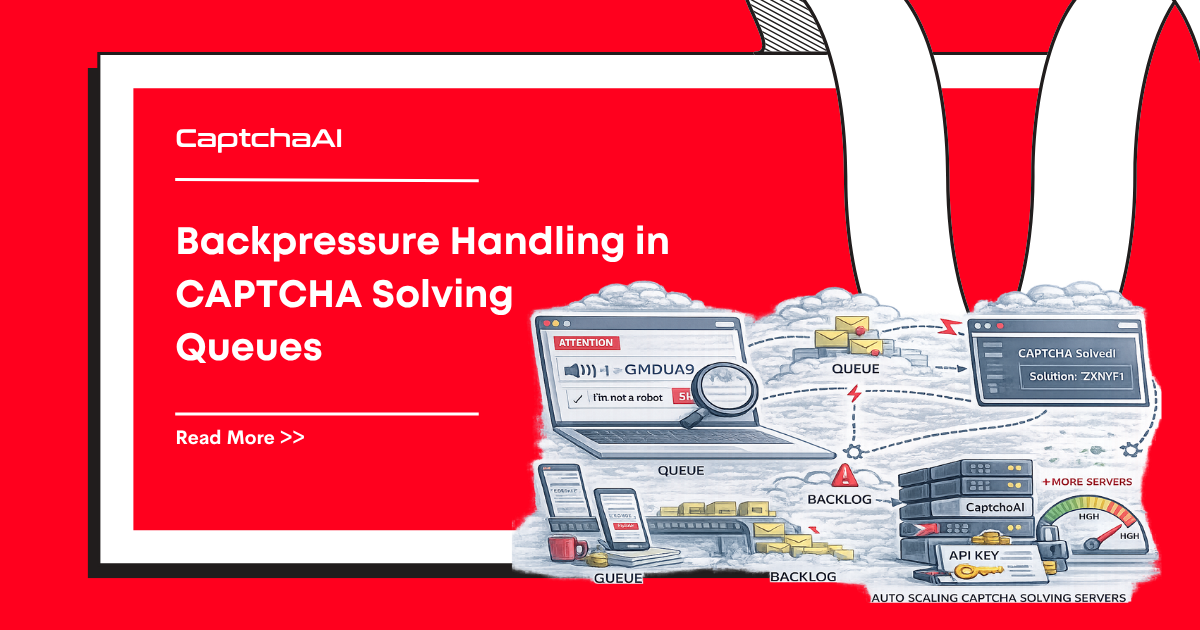
How do I handle queue backpressure?
Limit the queue size and reject or delay new submissions when full. The ConcurrencyQueue pattern handles this naturally.
Summary
Node.js excels at concurrent I/O — perfect for CAPTCHA queue systems with CaptchaAI. Use Promise.allSettled for simple batches, EventEmitter for progress tracking, priority queues for business-critical flows, and retry queues for reliability.
Related Articles
Full Working Code
Complete runnable examples for this article in Python, Node.js, PHP, Go, Java, C#, Ruby, Rust, Kotlin & Bash.
View on GitHub →



Discussions (0)
Join the conversation
Sign in to share your opinion.
Sign InNo comments yet.